Drawing Board Frequently Asked Questions
What is a parallel motion drawing board?
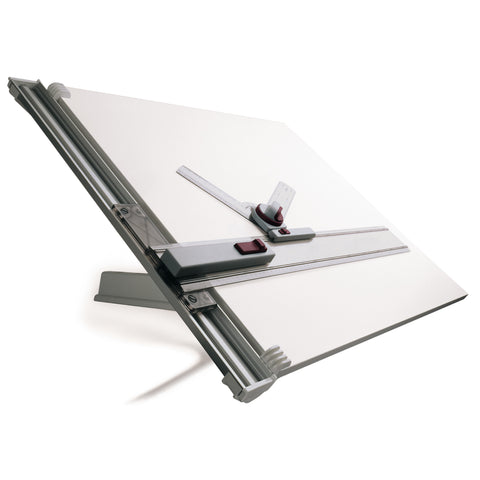
A parallel motion drawing board has a straightedge that is mechanically linked to the board via a wire and pulley system, keeping it perfectly horizontal at all times as you move it up and down the board. This allows you to draw accurate parallel horizontal lines anywhere on the board without needing to realign the straightedge. Most also have a rotating head so you can set and lock angles for drawing consistent diagonal lines. Parallel motion boards are the standard choice for architects, technical draughtsmen and design students.
What size drawing board do I need?
The size of drawing board you need depends on the largest paper size you regularly work with. An A1 board accommodates A1 paper (594 x 841mm) and is the preferred choice for professional architects and designers working on large-scale drawings and plans. An A2 board is the most popular all-round size — large enough for most technical drawing work but more compact and easier to use on a desk. An A3 board is ideal for students who primarily work at A3 and need a lightweight, portable option. If you work with A0 paper or large-format prints, a full drafting table such as the Denby Mutoh is the right choice.
What is the difference between a drawing board and a drafting table?
A drawing board is a desktop unit — it sits on your existing desk or work surface and can be adjusted to different working angles using a backstand. A drafting table is a freestanding unit with its own adjustable legs, height mechanism and often a built-in drafting machine or parallel motion arm. Drawing boards are the right choice for most students and design professionals who have a desk to work from. Drafting tables are the choice of professional architects and engineers who need a dedicated, full-time drawing station with maximum stability and precision.
What is the difference between a drawing board and a drafting machine?
A drawing board provides a flat, stable working surface with a parallel motion straightedge for drawing horizontal and angled lines. A drafting machine goes further — it mounts a drafting head directly onto the board via a parallelogram arm mechanism, providing both horizontal and vertical scales that move together and can be rotated to any angle. Drafting machines give greater precision and speed for complex technical work. The Denby Mutoh range we stock combines a quality drawing table with a precision Japanese-made Mutoh drafting head.
Which drawing board is best for architecture students?
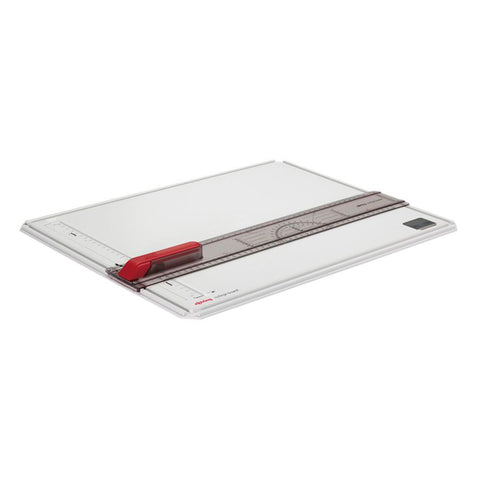
For architecture students, the GraphicPro A2 or A1 drawing board with parallel motion is the most popular choice — it gives professional-quality results at an accessible price, and is used by thousands of students across UK architecture schools. The Rotring A3 College Board is a good option for students who primarily work at A3 scale. If your course requires A1 working, the GraphicPro A1 board gives you the larger working area without the premium price of the Rotring or Orchard ranges. Many of our university partners specify the GraphicPro range for first-year students.
What does 17mm laminated board surface mean?
The 17mm measurement refers to the thickness of the drawing board surface itself. A thicker board provides greater rigidity and resistance to warping, which is important for accurate technical drawing work — a thin or flexible board can introduce subtle distortions into your lines. The laminated surface gives a smooth, durable drawing area that accepts paper well and withstands the wear of daily use. The GraphicPro boards use a 17mm laminated surface as standard, giving a noticeably more solid feel than cheaper thin-board alternatives.
Can I use a drawing board for watercolour or wet media?
Drawing boards with parallel motion are designed primarily for technical drawing — pencil, pen and ink, technical drawing pens and fine liner work on paper, tracing paper and drafting film. They are not recommended for wet media such as watercolour, as moisture can damage the board surface and warp the paper. For wet media work you would typically use a separate easel or a plain board without the parallel motion mechanism, stretching your paper beforehand.
Do drawing boards come with set squares and accessories?
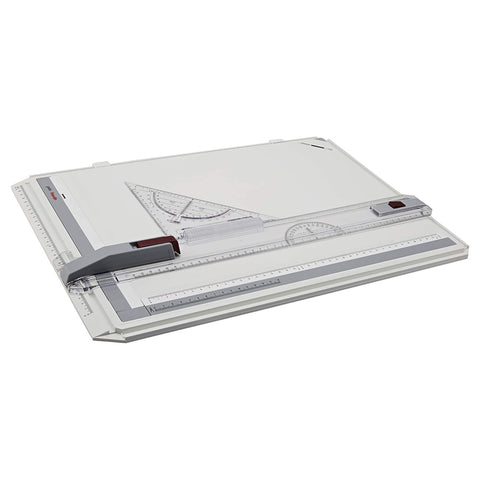
Most drawing boards come with a parallel motion straightedge as standard. The Aristo A4 Geo-Board includes a rapid set square and compass plotting scale as part of the package. The Rotring A2 board includes a drafting head as standard. For additional accessories — set squares, scale rules, templates and compasses — we stock a comprehensive range of technical drawing instruments separately. Drawing board clips for securing paper are also available, compatible with all standard board thicknesses up to 22mm.
Are drawing boards still used by architects and designers?
Yes — while CAD software has become standard in most practices, drawing boards remain widely used for freehand sketching, concept development, presentation drawings, site sketches and teaching. Many architecture schools still require students to master manual drawing before moving to digital tools, as it develops a fundamental understanding of proportion, scale and spatial reasoning. Professional architects and designers also find that working by hand at a drawing board encourages a different kind of thinking to working on screen. Drawing boards are also essential for technical draughtsmen, surveyors and engineers who work with paper drawings.
What accessories do I need with a drawing board?
The essential accessories for a drawing board are: a set of set squares (typically a 45-degree and a 30/60-degree), a scale rule appropriate to your discipline (an architect's triangular scale rule covers all the standard architectural scales), a good supply of drawing board clips to secure your paper, and a selection of technical drawing pencils or a mechanical pencil in 0.3mm, 0.5mm or 0.7mm. A roll of low-tack masking tape is useful for securing tracing paper overlays. If you use technical drawing pens, a bottle of technical drawing ink and pen cleaner are also worth keeping to hand.